

The Complete Uk lawn glossary
The Complete UK Lawn Care Calendar & Glossary
Everything you need to know about lawn care, month by month. Every term explained. Built for UK and Irish gardeners.
12 Months 115+ Terms 11 Diseases 7 Pests 30+ Years Experience
Timing is everything with lawn care. Get it right and your lawn practically looks after itself. Get it wrong and you end up fighting the same problems year after year. This calendar gives you the exact timing for every major lawn task across the UK and Ireland, with regional adjustments where they matter.
After spending 20 years as a professional greenkeeper and another decade running lawn care businesses, I have seen what works and what does not. The biggest mistake people make is not the products they use or the equipment they buy. It is timing. They scarify too early, feed too late, or try to overseed when the soil is too cold for germination.
This guide applies to all soil types across the UK and Ireland, whether you are dealing with sandy soil that drains quickly, loamy soil that holds nutrients well, or heavy clay that stays wet longer. The principles are the same, though clay lawns may need more aeration and sandy lawns may need more frequent feeding.
This calendar is built around how grass actually grows in our climate. I will explain not just what to do each month, but why that timing matters. Because once you understand the "why," you will never have to guess again.
Quick Navigation
Understanding UK and Ireland Growing Seasons
Before we get into the month by month detail, you need to understand why timing varies so much across our islands. It all comes down to soil temperature.
The Science Made Simple
Grass roots only grow actively when soil temperature is above 6°C. Leaf growth kicks in properly around 8 to 10°C. This means your lawn might look green but have dormant roots in early spring, or brown off in summer while roots stay active. Knowing this changes everything about when you should be doing what.
| Region | Growing Season | Notes |
|---|---|---|
| South of England | Pretty much year-round | Mild winters mean grass rarely stops completely |
| Midlands | March to early November | Typical UK pattern |
| Northern England | Late March to October | Shorter but intense growing season |
| Scotland | April to September/October | Highland areas are even shorter |
| Wales | March to November | Coastal areas similar to South England |
| Northern Ireland | March to early November | Maritime influence extends seasonally |
| Republic of Ireland | March to November | Milder west coast, similar to South England |
The key point is this: adjust all timing in this calendar based on your local conditions. If you are in the Scottish Highlands, everything shifts later in spring and earlier in autumn. If you are on the south coast of England, your lawn might not stop growing at all. That said, lawn care should be fun, so use this as a rough guide and tweak it for your specific area.
iGrow Carpet Feeding Schedule
Here is the recommended feeding schedule using iGrow Carpet products throughout the year. We recommend feeding every 10 weeks during the growing season, with seaweed applications year-round and iron used strategically for colour and moss control.
| Season | Months | Granular Feed |
|---|---|---|
| Winter | December to February | Winter Feed + Green Shot Iron & Seaweed as needed |
| Spring | March, April, May | Spring Starter Plus |
| Summer | June, July, August | Summer Advance |
| Autumn | September, October, November | Autumn Lawn Builder |
Understanding what each nutrient does helps you pick the right feed. Tap any nutrient below:
N
Nitrogen
Growth engine
P
Phosphorus
Root builder
K
Potassium
Stress shield
Fe
Iron
Colour boost
Mg
Magnesium
Deep green
Seaweed
Seaweed Lawn Booster can be applied year-round once a month. It supports soil health, strengthens roots, and helps the grass cope with whatever the weather throws at it.
Green Shot Iron
Green Shot Iron is brilliant for boosting colour and helping to hold moss back, but use it wisely. Too much of a good thing can become a bad thing. Here is a sensible approach:
- Late autumn: Medium dose to hold moss back heading into winter
- Winter: Higher dose when moss is at its worst
- Throughout the year: Lower doses as needed to top up colour
The measurement tool will help you determine exactly how much you need for your lawn at each application rate.
Why the Seasonal Power Packs Work
Every season on this page comes down to the same two jobs. Feed the grass above the surface, and look after the soil and roots underneath it. The granular feed handles the first job. Seaweed handles the second. Neither can do the other's work, because they work in completely different ways.
That is all a Seasonal Power Pack is: the right granular feed for the season, plus a bottle of Seaweed Lawn Booster, at 10% less than buying them separately. There is a Spring, Summer and Autumn version, so you cannot pick the wrong feed for the time of year, and at the start of each season (March, June and September) the calendar below points you straight at the right one. It is the exact pairing I use on the lawns I look after, and it is the first thing I point people at when they ask where to start.
Winter is the one exception. Growth stops, so there is no feed pack. Instead the winter months run on the Greenkeeper's Secret Formula, the iron and seaweed pairing that holds the lawn through to spring. You will find it in December and January below.

Winter Months
January
January is about protection, not progress. Your lawn is dormant or nearly dormant, and any work you do now risks causing damage that will show up for months.
Stay Off When Frozen or Wet
Walking on frozen grass breaks the cell walls. You will see your footprints as brown, dead grass for weeks afterwards. Waterlogged lawns compress under foot traffic, damaging soil structure.
Green Shot Iron & Seaweed
Through the winter months, Green Shot Iron and Seaweed Lawn Booster are your main tools. They help hold moss back, maintain colour, and support soil health. You do not need to apply every month. Use them as conditions require.
Winter Feed on Light Soils
If your lawn is on free draining or sandy soil, or you seeded in autumn, a winter feed in January keeps the roots supplied while everything up top sleeps. Heavier soils hold their autumn feed for longer and can usually wait until spring.
Aerate High Traffic Areas
Winter is a great time to get the fork out. Focus on high traffic areas first, then move to other areas if conditions allow. This relieves compaction while the lawn is dormant.
Mow When Conditions Allow
If the ground is firm, the weather is dry, and the grass has put on some growth, there is no reason not to mow. Keep the mower on the highest setting and just take the tips off. The key is the conditions, not the calendar.
Clear Debris
Remove fallen leaves, branches, and any other debris when conditions allow. Debris left sitting creates bare patches and encourages disease.
Edge the Lawn
If ground conditions allow, January is a good time to get your edges tidied up. Clean edges make a huge difference to how the lawn looks.
Service Equipment
Get your mower in for a service before the spring rush. Blunt blades tear grass rather than cutting it cleanly, leaving brown tips. Beat the queues by booking early.
Plan Ahead
Measure your lawn so you know exactly how much product you need for the season. No guessing, no waste, no running out halfway through.
Watch for: Fusarium Patch
Late Autumn → WinterMore of a risk on ornamental lawns with bentgrass and fescue. Orange-brown patches with white/pink edges in cool, damp conditions. Green Shot Iron can help hold it back, but serious cases may need treating with a fungicide.
Regional Note: In the South of England, you might get mild spells where grass continues to grow slowly. If it does, you can do a very light top at the highest setting, but only if conditions are dry. Scotland and Northern Ireland will see little to no growth.
What to Buy in January
Winter Ready Pro
The feed for light soils in winter. It is deliberately light on nitrogen, so it will not push soft growth into the frost. Instead it works below the surface, feeding the roots and building the winter hardiness that gets a free draining lawn through to the spring feed in one application.
From £24.99
Shop Now
What to Buy in January
The Greenkeeper's Secret Formula
Seaweed Lawn Booster + Green Shot Iron
The iron and seaweed above are your winter holding pair: colour, moss held back, and soil health ticking over while the grass sleeps. The Secret Formula is simply both together with 10% off. If you are stocking up for the rest of winter, this is the way to do it.
Planning tip: Use our Lawn Measurement Tool to work out exactly how much fertiliser you will need for the year. Getting accurate measurements means no waste and no running short.
January Tips
- Apply Green Shot Iron and Seaweed as conditions require to hold moss back and support soil health
- Winter feed on free draining or sandy soils, or where you seeded in autumn
- Aerate high-traffic areas with a fork
- Mow when ground and weather conditions allow (highest setting, tips only)
- Edge the lawn if ground conditions allow
- Get the mower serviced before the spring rush
- No scarifying. You will rip out the grass, and it cannot recover.
- No weed treatment. It simply will not work when nothing is growing.
February
February is a transitional month. In the south, you might start to see signs of life. Further north, it still looks and feels like winter. Watch your lawn, not the calendar.
Watch for First Growth
Look for the grass starting to green up and put on height. This is your signal that the growing season is approaching.
Keep On Top of Moss
If moss is creeping in, a Green Shot Iron application now helps hold it back before the grass starts competing properly in spring. You do not need to go heavy, just enough to keep it in check.
Continue Debris Clearance
Any leaves or debris that have accumulated over winter need to go. Light raking is fine if conditions are dry.
Order Products
Get your spring fertiliser and any other products ordered now. Do not leave it until March when everyone is panic buying.
Why Treat Moss Now?
Moss spreads through spores and thrives when grass is weak. By applying iron in late winter, you help hold the moss back while it is actively growing but before the grass needs to compete for space. This gives your grass a clear run when it wakes up in spring.
What to Buy in February
Green Shot Iron
This is where it really shines. The iron helps hold the moss back while giving your grass a colour boost, and you will see the moss start to weaken within days, making it easier to rake out before spring growth kicks in. Get it down now and your grass gets a clear run at spring.
£22.99
Shop Now
Watch for: Leatherjackets
Feb–May Peak DamageYellow patches, birds pecking lawn aggressively? Lift a section and check for grey-brown legless grubs, but just because you don't find them doesn't mean they're not there. No legs means leatherjackets (not chafer grubs, which are white with legs). If symptoms are present, treat anyway.
Regional Note: South of England may see first mowing opportunity in late February during mild years. Scotland and Northern Ireland are typically still fully dormant. The Midlands and Northern England sit somewhere between.
February Tasks Checklist
- Apply Green Shot Iron to hold moss back (late February in milder areas)
- Light rake to remove debris when dry
- Check drainage and address waterlogged areas
- Sharpen mower blades if not done in January
- Order spring products
Spring Months
March
March is when it all starts to happen. The soil is warming, daylight hours are increasing, and your lawn is waking up. This is the month that sets up your entire year.
First Mow of the Season
When the grass reaches 50 to 60mm, take the first cut. Set the mower to the highest setting and remove only the top third. Never scalp.
Spring Feed Application
Once grass is actively growing (usually mid to late March in most areas), apply a spring fertiliser. The higher nitrogen content fuels leafy growth.
Rake Out Dead Moss
If you treated moss in February, it should be weakened by now. Rake it out before applying fertiliser.
Assess Lawn Condition
Now you can see what survived winter. Note bare patches, thin areas, and where weeds have moved in.
Why Spring Feed Matters So Much
After winter dormancy, grass has depleted its carbohydrate reserves. The plant literally ran on stored energy while it could not photosynthesise properly. A spring feed provides the nitrogen it needs to produce chlorophyll (the green stuff that captures sunlight) and start building reserves again. Feed too late, and you are playing catch-up all season.
Pro Tip: For your first couple of cuts of the season, keep the mower on a high setting and only take the tips off. Your grass has been through winter stress and needs time to build strength. Gradually lower the cutting height over several weeks once the lawn is growing strongly.
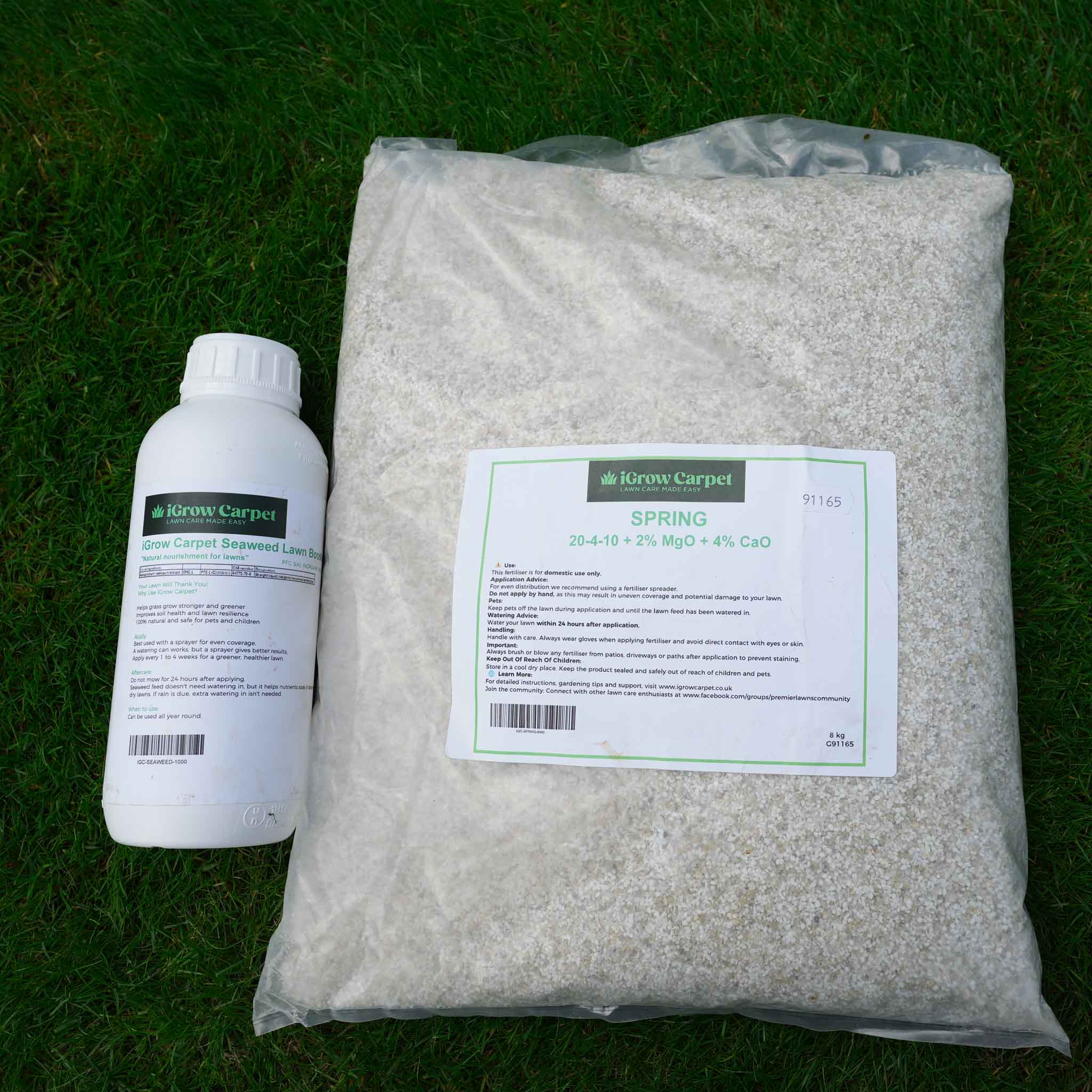
What to Buy in March
Spring Power Pack
Spring Starter Plus + Seaweed Lawn Booster
The wake-up feed gives grass the push it needs coming out of dormancy, releasing slowly over 8 to 10 weeks so you are not pushing flushes of weak growth. The seaweed feeds the soil underneath so the grass can actually use it. Both jobs done in one pack, at 10% less than buying them separately.
Regional Timing:
• South England: Early to mid March
• Midlands/Wales: Mid to late March
• Northern England: Late March
• Scotland: Late March to early April
• Northern Ireland/Republic of Ireland: Mid to late March
• South England: Early to mid March
• Midlands/Wales: Mid to late March
• Northern England: Late March
• Scotland: Late March to early April
• Northern Ireland/Republic of Ireland: Mid to late March
March Action List
- First mow when grass reaches 50 to 60mm (highest setting)
- Apply spring fertiliser once growth is active
- Rake out treated moss before feeding
- Note any areas needing attention
- Do NOT scarify yet, grass is not strong enough
April
April is the prime growing time. Temperatures are rising, soil is warming, and your lawn should be showing noticeable growth each week. This is when regular maintenance becomes important.
Regular Mowing Begins
You should be mowing weekly now in most areas. Gradually lower cutting height over several cuts but never remove more than one third at a time.
Weed Control Window Opens
Weeds are growing actively now, which means they will absorb the weed killer properly. Best results when weeds are young, and temperatures are 10 to 20°C.
Overseeding Opportunity
Soil temperature should be warm enough for germination. Good time to fill in any bare patches or thin areas.
Consider Watering
April can be dry. If we get a dry spell and the lawn looks stressed, consider watering deeply but infrequently.
The One Third Rule Explained
Grass stores carbohydrates in the lower portion of the blade and in the crown. When you cut off more than one-third of the blade height, you remove too much photosynthetic capacity, and the plant has to draw on its reserves to recover. Do this repeatedly, and you weaken the grass, making it more susceptible to stress, disease, and weed invasion.
Target mowing height for most UK lawns is 30 to 50mm with a rotary mower. If you have a cylinder mower and want a finer finish, 10 to 30mm is the range to work in. Either way, work your way down gradually over April and May, not all at once.
Watch for: Leaf Spot
Spring RiskDark spots or lesions on grass blades in cool, wet weather. Don't overfeed with nitrogen in damp conditions.
Pro Tip: If you are planning a full renovation this year (scarifying, overseeding, the works), April is not the time. I know it is tempting, but wait until September. Spring renovations have to compete with summer stress before they are established. Autumn renovations have mild conditions and the whole winter to develop roots.
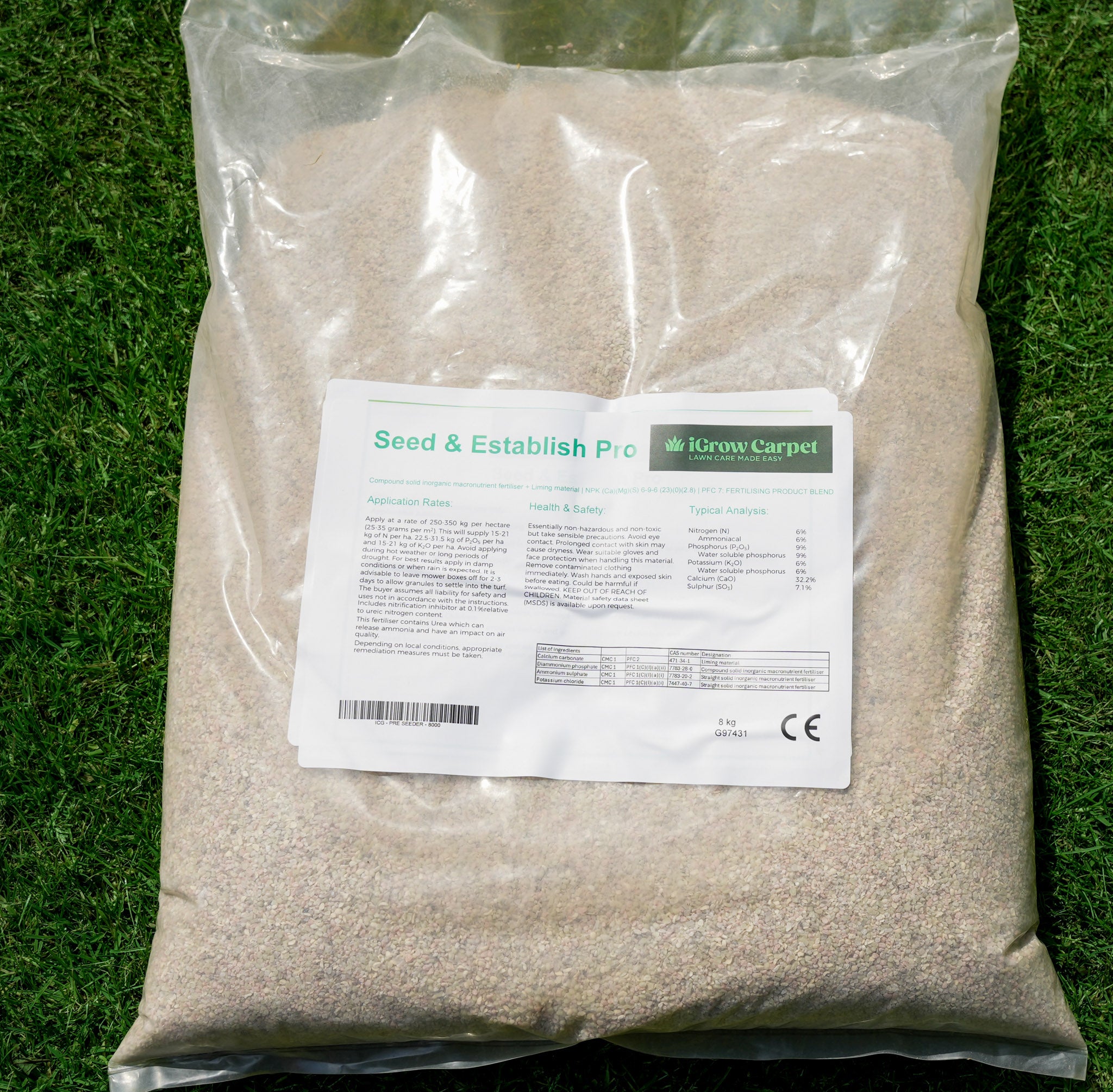
What to Buy in April
Seed & Establish Pro
5.0 (4 reviews)
Patching thin or bare areas this month? This is the feed to pair with spring overseeding. It looks after the new seedlings without overwhelming them. Save the stronger seasonal feed until the new grass is up and established.
From £24.99
Shop Now
April Action List
- Mow weekly, gradually lowering height
- Apply weed killer if needed (spot treat or blanket spray)
- Overseed bare patches (keep watered)
- Light scarifying is possible if the lawn is strong and established
- Water if the dry spell exceeds 7 to 10 days
May
May is the peak growth month in most of the UK. Your lawn is probably growing faster now than at any other time of year, with the spring flush in full swing. This is both brilliant and demanding.
Mowing Twice Weekly?
Growth can be so vigorous in May that weekly mowing is not enough to stick to the one-third rule. Consider mowing every 4 to 5 days.
Consider Summer Feed
If your spring feed was early March, it will be running out by late May. Time to think about switching to a summer formulation.
Final Weed Control Window
After May, weed killers become less effective as leaf surfaces harden. Get any remaining weed treatment done now.
Watering Becomes Important
May can surprise us with dry warm spells. Established lawns are fairly drought-tolerant, but newly seeded areas need consistent moisture.
By the end of May, you should have reached your target mowing height. The lawn should be thick, green, and growing strongly. If not, something went wrong earlier in the season, whether due to timing, product choice, or underlying soil issues.
Watch for: Red Thread
Late Spring → AutumnPink/red needle-like strands on leaf tips with bleached patches. Very common and usually a sign the lawn needs feeding. A nitrogen boost often helps it grow out.
The switch to summer feed happens in June, not May. If your spring feed went down in mid March it will carry you through this month, and if you are only getting started now, the spring feed is still the right one to put down.
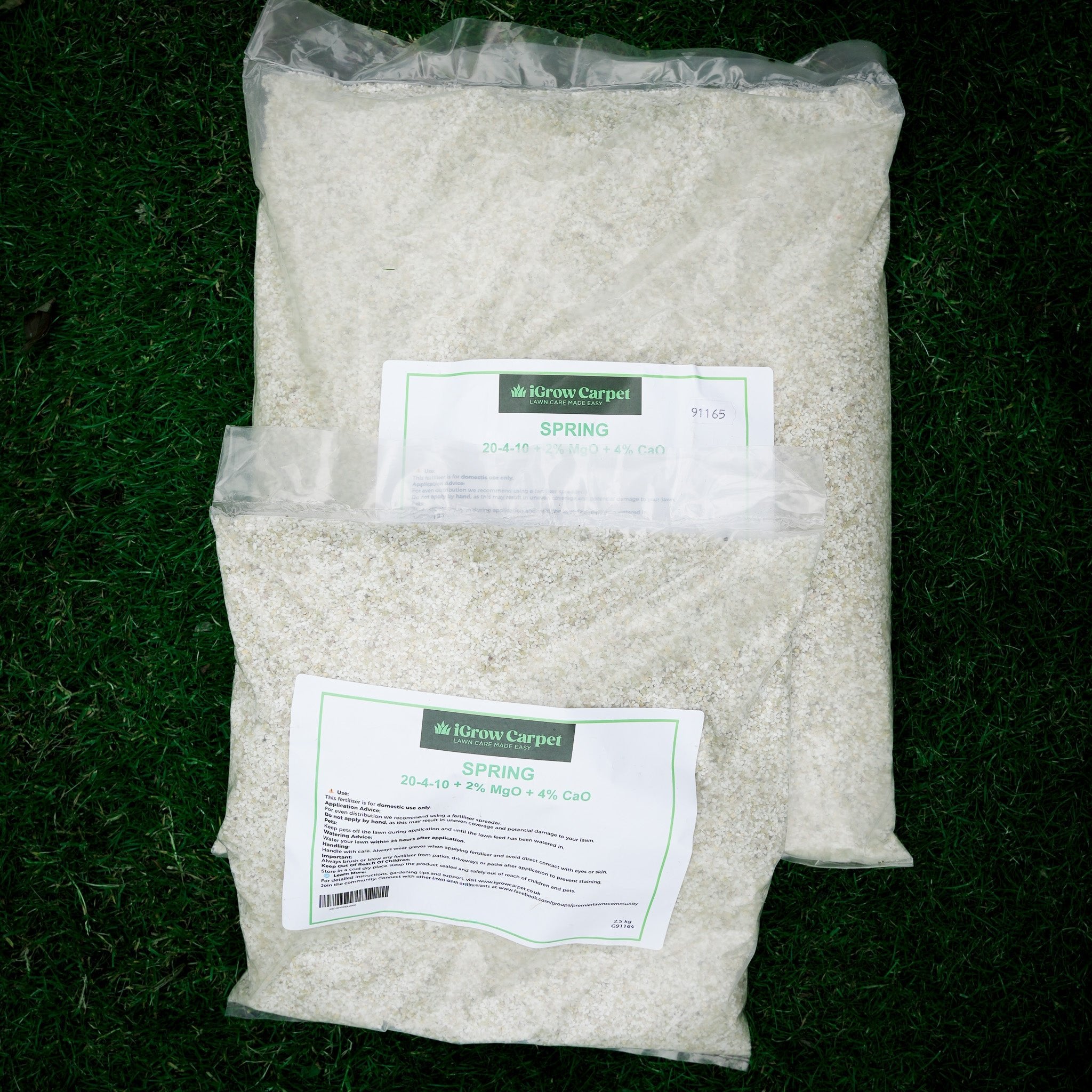
What to Buy in May
Spring Starter Plus
4.8 (5 reviews)
Still the right feed in May. If this is your first feed of the year, or your March application is running out, another round of Spring Starter Plus carries the lawn through peak growth. The summer switch happens in June.
From £24.99
Shop Now
Regional Note: Scotland and Northern Ireland may still be in full spring growth mode in May. Adjust your summer feed timing based on when your spring feed went down, not the calendar.
May Action List
- Mow frequently enough to maintain one third rule
- Complete any weed treatment
- Plan summer feed timing
- Water during dry spells (deeply, not little and often)
- Edge beds and borders for clean lines

Summer Months
June
June often brings our best lawn weather. Long days, warm soil, and usually enough rain to keep things growing nicely. This is when your hard work in the spring really pays off.
Regular Mowing Routine
Stick to your schedule. Weekly should be fine now that the spring flush has passed. Cut in different directions each time to encourage tillering.
Summer Feed Window
Early June is ideal for summer feed if your spring application was in March. This carries the lawn through to late summer.
Support Soil Health
A seaweed application now strengthens roots and helps grass cope with any summer stress coming.
Water Wisely
If watering is needed, do it early morning. One deep soak beats five light sprinkles. Train roots to go deep.
Why Seaweed Is Not Just Hippy Nonsense
Seaweed contains cytokinins and auxins, plant hormones that promote cell division and root growth. It also contains betaines, which help plants retain water under stress. Research shows that seaweed-treated turf recovers faster from drought and has deeper roots. This is not mystical, it is biochemistry.
Watch for: Ants
Spring → SummerSoil mounds appearing on the lawn surface. Brush or rake away before mowing to prevent smearing.
What to Buy in June
Summer Power Pack
Summer Advance + Seaweed Lawn Booster
A new season starts, and the feed changes with it. The spring feed you put down in March is running out about now, and Summer Advance takes over: steady nutrition built for summer conditions without pushing soft, disease prone growth. The seaweed in the pack builds the drought resilience the lawn is about to need. Both jobs done in one order, at 10% less than buying them separately.
June Action List
- Apply summer fertiliser if due
- Summer Power Pack if your feed is due: the summer feed plus seaweed in one go
- Mow regularly, alternating direction
- Water deeply if needed (not little and often)
- Keep an eye out for early signs of disease
July
July is usually our warmest month, but UK summers are unpredictable. Some years bring weeks of dry heat and drought stress. Other years, July is wet and the lawn keeps growing happily. How you manage this month depends entirely on what the weather throws at you.
Adjust Mowing to Conditions
UK summers vary massively. If it is hot and dry, raise your cutting height by 10 to 15mm. Longer grass shades soil, reduces evaporation, and develops deeper roots. But if July brings plenty of rain (which it often does), carry on mowing at your normal height. Let the weather guide you, not the calendar.
Water Smart
If you are going to water, do it properly. 25mm of water once a week is better than 5mm every day. Deep watering encourages deep roots.
Avoid Stress Activities
No scarifying. No heavy feeding. No weed killer. The lawn is stressed enough without adding to it.
Accept Some Dormancy
If your lawn turns brown during a drought, it is not dead. It has gone dormant. It will recover when rain returns.
Why Brown Does Not Mean Dead
Cool-season grasses (which are what we grow in the UK) have evolved to survive drought by going dormant. The leaves die back, but the crown and roots stay alive. As long as drought does not exceed 4 to 6 weeks, recovery is usually complete within 2 to 3 weeks of rain returning. Watering to keep grass green during drought just encourages shallow rooting.
Watch for: Cutworms
SummerSmall circular dead patches where grass stems are cut at soil level. Most active in dry summers. Dig around at night to check.
Pro Tip: If you are going on holiday in July, mow the lawn just before you leave, but raise the height slightly. Do not scalp it, thinking you will not have to mow for longer. You will come back to a stressed, patchy mess.
What to Buy in July
Seaweed Lawn Booster
5.0 rated
The one product that earns its place in July. It is a biostimulant rather than a fertiliser, so there is no risk of pushing growth the lawn cannot support in the heat, and the betaines in it help the grass hold onto water, which is exactly the help it needs in a dry spell. A monthly application through summer is cheap insurance.
£24.99
Shop Now
July Action List
- Raise mowing height only if conditions are hot and dry, otherwise carry on as normal
- Water deeply or not at all (no light sprinkling)
- Leave clippings on the lawn to conserve moisture
- Avoid granular feeding in extreme heat, but seaweed is safe to apply
- Do not panic if the lawn goes brown
August
August is a month of two halves. Early August can be as challenging as July. But by late August, conditions often improve, and we start thinking about autumn preparation.
Return to Normal Mowing
As temperatures moderate, you can start lowering the mowing height. Do it gradually over 2 to 3 cuts.
Plan Autumn Renovation
If you are planning to scarify and overseed, now is the time to plan it. September is the window you are aiming for.
Feed Only If Due
A June summer feed carries the lawn for around 10 weeks, so most lawns do not need feeding in August. The autumn feed comes in September with the renovation window. Hold off rather than feeding twice.
Welcome the Rain
August showers after a dry July are exactly what your lawn needs. You will be amazed how fast it bounces back.
The key psychological shift in August is from maintenance mode to preparation mode. You are no longer just keeping the lawn alive. You are setting it up for its best growing window of the year.
Grub Season: Chafer Grubs vs Leatherjackets
Late summer is when both types of grub are young and most vulnerable to treatment. The key is knowing which one you are dealing with:
Chafer Grubs
White, C-shaped, with legs. Turf lifts like a carpet. Badgers and foxes dig the lawn at night to get at them. Treat with nematodes (Heterorhabditis bacteriophora) in late summer when soil is above 12°C.
Leatherjackets
Grey-brown, no legs. Yellow patches, birds pecking aggressively at the lawn. Crane flies lay eggs in late summer, so treat with nematodes (Steinernema feltiae) in September/October when grubs are small and soil is above 12°C. Just because you don't find them on inspection doesn't mean they're not there. If symptoms are present, treat anyway.
The difference matters because they need different nematode species. If you are seeing damage now, lift a section of turf and check what is underneath. Legs means chafer. No legs means leatherjacket.
What to Buy in August
The Greenkeeper's Liquid Combo
Green Shot Liquid Plus + Seaweed Lawn Booster
August is bounce-back month, and your June feed is still doing the heavy lifting on nutrition. What the lawn wants now is recovery and colour, and they are both liquid jobs. The seaweed helps the roots and soil recover from whatever July threw at them, and Green Shot Liquid Plus brings the rich, dark colour back in days without pushing soft growth. 10% less than buying the pair separately.
Regional Note: Scotland may have an even shorter window between summer conditions easing and autumn arriving properly. If you are planning renovation work, be ready to move quickly once conditions are right, which might be late August rather than September.
August Action List
- Gradually return to normal mowing height
- Book equipment if hiring a scarifier
- Order seed and autumn products
- Hold off on feeding unless your 10 weeks are up
- Repair any irrigation damage or worn areas
Autumn Months
September
September is the single most important month in the lawn care calendar. This is your renovation window. Soil is still warm from summer, nights are getting longer, weed competition is decreasing, and you have months of mild weather ahead for establishment.
Scarifying Time
Early to mid-September is the prime scarifying time. Remove thatch and moss that has built up over the year.
Aeration Window
Aerate after scarifying. Whether hollow tine or solid tine, this relieves compaction and improves root growth.
Overseeding Opportunity
The best time of year to overseed. Soil is warm, air is cool, and the seed has months to establish before summer stress.
Autumn Feed
Apply autumn fertiliser to support root development and build winter hardiness. Lower nitrogen, higher potassium.
Why September Is So Special
Grass seed germinates best when soil temperature is 10 to 18°C. In September, soil retains summer warmth while air temperatures have cooled. This means rapid germination without the stress of summer heat or the risk of drought. New grass then has October, November, and often into December of root growth before going dormant. Come spring, it is properly established.
The September renovation sequence goes like this: mow low, scarify, aerate (optional but recommended), overseed, top dress (optional), feed, water if needed. This is covered in detail in our scarifying guide and overseeding guide.
Autumn Lawn Builder is formulated specifically for this period. It gives the lawn enough nitrogen to recover after renovation, drives the root development that matters at this time of year, and builds the stress tolerance the grass needs heading into winter. It is what I use on every lawn I work on.
What to Buy in September
Autumn Power Pack
Autumn Lawn Builder + Seaweed Lawn Booster
A new season, a new pack. If you are feeding rather than renovating this month, this is the September buy: Autumn Lawn Builder switches the lawn onto root development and winter hardiness, and the seaweed keeps the soil working as top growth slows. The pair costs less together than bought separately.
Watch for: Fusarium Patch
Autumn → SpringThe most common UK lawn disease. Orange-brown patches with white/pink edges in cool, damp conditions. Reduce nitrogen going into autumn.
Protect new seed from: Slugs
Wet WeatherIf you are overseeding, slugs will mow down new seedlings overnight. Use pellets around new seed and water in the morning.
Pro Tip: If you are overseeding, use Seed & Establish Pro before sowing and save the Autumn Lawn Builder for 4 to 6 weeks later. Seed & Establish Pro gives the new seedlings exactly what they need without overwhelming them.
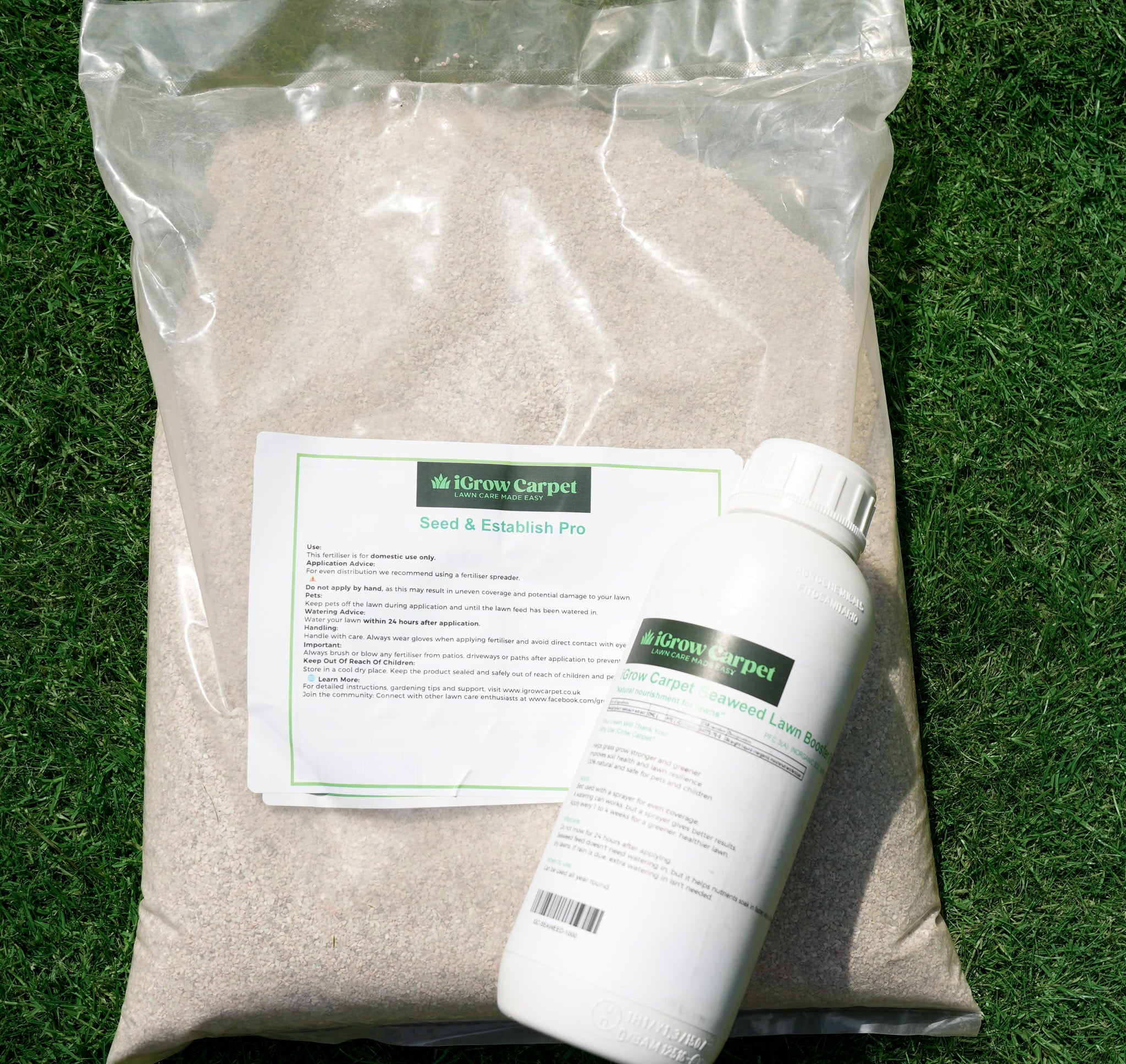
What to Buy in September
Seeding Success Duo
Seed & Establish Pro + Seaweed Lawn Booster
Renovation month deserves the renovation pair. Seed & Establish Pro works on the roots first, getting seedlings anchored quickly instead of pushing soft top growth they cannot support yet, and the seaweed speeds up establishment and gets the soil working for the new grass. Both together save you 10% on buying them separately.
Regional Timing:
• South England: Mid September ideal
• Midlands/Wales: Early to mid September
• Northern England: Early September
• Scotland: Late August to early September
• Northern Ireland/Republic of Ireland: Early to mid September
• South England: Mid September ideal
• Midlands/Wales: Early to mid September
• Northern England: Early September
• Scotland: Late August to early September
• Northern Ireland/Republic of Ireland: Early to mid September
September Action List
- Scarify to remove thatch and moss
- Aerate compacted areas
- Overseed thin or bare patches
- Apply appropriate fertiliser
- Keep newly seeded areas moist
- Continue mowing, but raise the height slightly
October
October is about recovery and establishment. If you did renovation work in September, you will see the results now. New grass should be coming through, and the existing lawn should be thickening up.
Continue Mowing
Growth slows but does not stop. Keep mowing as needed, raising height as the month progresses.
Leaf Management
Fallen leaves left on the lawn block light and encourage disease. Clear them regularly or mow over them to mulch.
Last Overseeding Chance
Early October is the last realistic window for overseeding in most areas. After mid-October, the soil gets too cold.
Feed If It Is Due
Whether you feed in October depends on your schedule. If it has been 10 weeks since your last granular feed, it is time to go again. But if you only fed in September, you will not need another one yet. Stick to the 10 week cycle rather than feeding by the calendar.
What Happens Underground
While top growth slows, root activity continues in October. The plant is diverting energy from leaf production to root development and carbohydrate storage. This is why autumn feeding matters. You are fuelling root growth and winter preparation, not just green leaves.
Watch for: Red Thread
Late Summer → AutumnPink/red needle-like strands on leaf tips. Usually a sign the lawn needs feeding. Give it some nitrogen and it will often grow right out of it.
Watch for: Rust
Late Summer → AutumnOrange powdery spores that rub off on shoes. Keep the lawn fed and mow regularly to remove affected tissue.
What to Buy in October
Autumn Lawn Builder
If your 10 weeks are up this month, this is the October feed. All the growth that matters right now is happening underground, and this is the feed built for exactly that: root development and winter hardiness rather than soft top growth that would only get knocked back by the first frost.
From £24.99
Shop Now
Do not be tempted to put the mower away too early. Grass that goes into winter too long is prone to disease and snow mould. Keep it tidy until growth stops properly.
Regional Note: South of England can expect growth to continue throughout October. Scotland and Northern Ireland will see slowdown by mid-October. The Midlands sits between these extremes.
October Action List
- Mow as needed (do not let it get too long)
- Clear leaves regularly
- Final overseeding if needed (early October only)
- Feed if it has been 10 weeks since the last application
- Service mower before storing
November
November marks the transition out of the growing season for most of the UK. The focus shifts from active maintenance to protection and preparation for winter. We generally do not get a lot of frost in November, that tends to come more in December.
Mow If Conditions Allow
No fixed last cut of the year. If the grass is growing and it is dry enough, mow it. Raise the height slightly heading into winter.
Seaweed and Iron Application
November is a great month to start applying seaweed and iron. The iron helps hold the moss back through winter while the seaweed supports soil health.
Keep Clearing Leaves
Trees drop most leaves in November. Stay on top of clearing them, especially in wet weather. Leaves left sitting will smother the grass.
Get the Mower Serviced
Book your mower in for a service now. Avoids the spring rush and means you are ready to go when growth starts next year.
Address Drainage Issues
If areas of your lawn hold water, November is when it shows. Note these areas for work next year.
Store Equipment
Clean spreaders and sprayers, drain fuel from equipment you will not use over winter or add stabiliser.
Watch for: Casting Worms
Autumn → SpringMuddy casts on the surface that smear when mown. Brush them when dry before mowing. They are a sign of healthy soil.
What to Buy in November
Green Shot Iron
November is the month to start your winter iron. It helps maintain colour through winter and holds moss back right as moss gets going. Pair it with Seaweed Lawn Booster for the soil health side, and use both as conditions require rather than every single month.
£22.99
Shop Now
In the South of England, you might still be mowing in November. Further north, the lawn is effectively dormant. Either way, the principle is the same: keep it tidy, keep it clear of debris, and do not damage it with traffic.
November Action List
- Mow when conditions allow (no fixed last cut)
- Clear fallen leaves regularly
- Apply seaweed and iron for moss control and colour
- Get the mower serviced
- Clean and store equipment
- Note any problem areas for next year
December
December is a quieter month for your lawn, and for you. But that does not mean you have to ignore it entirely.
Stay Off When Frozen
As with January, walking on frozen grass causes lasting damage. Keep off until it thaws.
Mow When Conditions Allow
If the ground is firm, the weather is dry, and there is some growth, you can still mow. Highest setting, just the tips. Let the conditions decide, not the month.
Green Shot Iron & Seaweed
If you did not apply in November, a Green Shot Iron and Seaweed application can help hold moss back and maintain colour through winter. You do not need to apply every month. Just use as conditions require.
Clear Debris After Storms
Winter storms drop branches and debris. Remove them when conditions allow.
Plan Next Year
Review what worked and what did not. Order products early while stocks are good.
Enjoy the Break
Seriously. The lawn does not need much from you right now. Take the time to recharge.
Year-round nuisance: Moles
Year RoundMolehills smother grass and tunnels disturb roots. Home remedies rarely work. Trapping or professional pest control are the only reliable solutions.
What to Buy in December
The Greenkeeper's Secret Formula
Seaweed Lawn Booster + Green Shot Iron
December is not about growing, it is about holding. The iron hardens the turf, keeps some colour in the lawn, and helps hold moss back at the exact time of year moss does its best work. The seaweed keeps the soil biology ticking over underneath it all. These are the same two products this page recommends right through winter, and the Secret Formula is simply the pair together with a few quid knocked off. If you are buying them anyway, buy them this way.
Regional Note: In the mildest parts of the South of England and coastal Ireland, grass may still show some growth in December. If it does and conditions are dry, a mow at the highest setting is fine. But do not force it.
December Action List
- Mow when ground and weather conditions allow
- Apply Green Shot Iron and Seaweed as needed (not necessarily every month)
- Stay off frozen or waterlogged lawn
- Clear any storm debris
- Plan next year's programme
- Early product ordering
Quick Reference: Monthly Task Overview
This table gives you a snapshot of the year. Use it as a quick reminder, but always adjust for your specific conditions and region.
| Month | Mowing | Feeding | Key Tasks |
|---|---|---|---|
| Jan | When conditions allow | Iron & Seaweed as needed; winter feed on light soils | Aerate high traffic areas, edge lawn, service mower |
| Feb | When conditions allow | Iron & Seaweed as needed | Hold moss back, debris clearance |
| Mar | First cuts | Spring feed | Start regular maintenance |
| Apr | Weekly | If needed | Weed control, overseeding patches |
| May | Weekly/twice | Spring feed if due; switch in June | Last weed treatment window |
| Jun | Weekly | Summer feed | Seaweed application, disease watch |
| Jul | Normal or raise if dry | No granular in heat; seaweed is fine | Water wisely if dry, accept dormancy in drought |
| Aug | Return to normal | Only if 10 weeks are up | Plan autumn renovation |
| Sep | Continue | Autumn feed | RENOVATE: scarify, aerate, overseed |
| Oct | As needed | If 10 weeks since last | Leaf clearance, last overseeding |
| Nov | When conditions allow | Seaweed + Iron | Hold moss back, clear leaves, service mower |
| Dec | When conditions allow | Iron & Seaweed as needed | Stay off frozen ground, plan next year |
Frequently Asked Questions
When should I start feeding my lawn in spring UK?
Start feeding when the grass is actively growing, not just when the calendar says spring. In the South of England, this is often mid March. In the Midlands and Northern Ireland, late March is typical. In Scotland and Northern England, early April is more realistic. Look for the grass putting on height and greening up properly before applying fertiliser.
When is the best time to scarify a lawn in the UK?
The best time to scarify is early to mid September. The soil is still warm from summer, the air is cooler which reduces stress on the grass, and there are months of growing time left for recovery. Spring scarifying is possible but less ideal because the lawn has to face summer stress before it has fully recovered.
How often should I feed my lawn UK?
We recommend feeding every 10 weeks during the growing season. This can be a mix of seaweed and iron applications in the late autumn and winter months, coupled with granular fertilisers in spring, summer and autumn. For lawns with free draining or sandy soil, you may also benefit from a granular feed around January, especially if you have done any autumn seeding that needs supporting through winter.
Can I overseed my lawn in spring?
Yes, you can overseed in spring (April/May), but autumn (September) is better. Spring seeding has to compete with weeds, risk drought in summer before establishment, and lacks the long mild growing period that autumn provides. If you must seed in spring, keep the area well watered and avoid any weed treatment for at least 6 weeks.
When is the best time to treat moss in a UK lawn?
Late winter (February) or early autumn (September/October) are the best times to tackle moss. Iron based products like Green Shot Iron help weaken the moss, making it easier to rake out. In late winter, treat the moss before the grass starts competing, then rake out the weakened moss and feed. In early autumn, you can treat moss before or after scarifying, then the grass has time to fill in the gaps. Avoid treating in summer heat or winter freeze.
What height should I cut my lawn UK?
For most UK lawns cut with a rotary mower, 30 to 50mm is the range to work in. Cylinder mowers can go lower, at 10 to 30mm, for a finer finish. In summer heat or drought, stay towards the top of your range to help the grass cope with stress. Never remove more than one third of the blade height in a single cut.
Should I water my lawn during a hosepipe ban?
Follow local water restrictions. Established UK lawns rarely die from drought. They go dormant and turn brown, but recover when rain returns. Prioritise watering newly seeded or newly turfed areas if any exemptions apply. Established lawns can wait.
When should I aerate my lawn?
The best time is September, ideally as part of your autumn renovation alongside scarifying and overseeding. You can also aerate in spring (April) if needed. Avoid aerating when the soil is too wet (it just creates a mess) or too dry (the tines cannot penetrate properly).
Is it too late to feed my lawn in October?
Not at all. October feeding with an autumn formulation (lower nitrogen, higher potassium) is excellent for building winter hardiness and supporting root development. The grass may not show much top growth, but it is actively growing roots and storing energy. Just avoid high nitrogen feeds which push soft growth that will not survive winter.
Why is my lawn different from my neighbour's?
Lawns vary enormously based on soil type, aspect (sun vs shade), grass species present, how they have been treated historically, and local microclimate. Even neighbouring gardens can be quite different. This is why you need to watch your lawn rather than just follow a calendar. Your lawn tells you what it needs if you pay attention.
This guide is part of the iGrow Carpet Learning Hub. For video guides on specific topics, check out our Spring Masterclass, Summer Guide, and Autumn Tips.
Nutrients at a Glance
The building blocks of a healthy lawn. Understanding what each nutrient does helps you diagnose problems and feed your lawn properly.
N
Nitrogen
Primary NutrientThe engine of your lawn. Drives leaf growth, green colour, and density.
Deficiency signs: Pale yellow-green colour, weak growth, thin lawn
Full entry →
P
Phosphorus
Primary NutrientRoot developer. Essential for establishing new grass and building strong root systems.
Deficiency signs: Poor root development, purplish tinge to leaves
Full entry →
K
Potassium
Primary NutrientThe toughener. Builds stress resistance, drought tolerance, and disease defence.
Deficiency signs: Brown leaf tips and edges, poor drought recovery
Full entry →
Fe
Iron
MicronutrientThe colour booster. Deepens green without pushing soft growth. Hardens turf and helps hold moss back.
Deficiency signs: Yellowing between leaf veins (interveinal chlorosis)
Full entry →
Mg
Magnesium
Secondary NutrientChlorophyll's core. The central atom in every chlorophyll molecule. Essential for photosynthesis.
Deficiency signs: Yellowing between veins, dull overall colour
Full entry →
S
Sulphur
Secondary NutrientNitrogen's partner. Helps grass use nitrogen efficiently. Also lowers soil pH.
Deficiency signs: Similar to nitrogen deficiency, overall yellowing
Full entry →
UK & Ireland Grass Types
These are the grasses that actually grow in our climate. Cool season grasses that thrive in mild, wet conditions and stay green year round.
Ryegrasses
The backbone of UK lawns. Fast to establish, hard wearing, and quick to recover from damage.
- Perennial RyegrassHard Wearing
Fescues
Fine-leaved grasses that tolerate shade and drought. Lower maintenance than ryegrass.
- Fescue familyShade
Bentgrasses
The golf green grasses. Create beautiful dense swards when mown low, but need more attention.
- BentgrassFine Turf
Meadow Grasses
The Poa family. Smooth-stalked is brilliant for self-repair, spreading to fill gaps naturally.
- Smooth-Stalked Meadow GrassSelf-Repair
Also known as: Kentucky Bluegrass (USA), Poa pratensis
Weed Grasses
Grasses you don't want in your lawn. They look different, grow differently, and spoil the uniform appearance.
- Annual Meadow GrassPoa annua
- Yorkshire FogFuzzy
- Couch GrassSpreader
- Rough-Stalked Meadow GrassPoa trivialis
- CocksfootClumpy
UK Lawn Pests
The creatures that can damage your lawn from above and below. Tap any pest for full identification, lifecycle, and control advice.
LeatherjacketsAutumn → SpringGrey-brown legless grubs eating grass roots. Yellow patches, birds pecking lawn.→ Chafer GrubsLate Summer → AutumnWhite C-shaped grubs with legs. Turf lifts like a carpet, animal digging.→ CutwormsSummerMoth caterpillars cutting grass stems at soil level. Circular dead patches.→ AntsSpring → SummerSoil mounds on lawn surface. Uneven mowing, smothered grass patches.→ MolesYear RoundLarge volcano-shaped molehills. Tunnels visible as raised ridges.→ Slugs & SnailsWet WeatherSlime trails, ragged damage to new seedlings and grass blades.→ Casting WormsAutumn → SpringSmall muddy casts on lawn surface. Smear when mown, create mud patches.→
UK Lawn Diseases
The 11 diseases you are most likely to encounter in UK lawns. Tap any disease for full details.
Fusarium PatchAutumn → SpringOrange-brown patches with white/pink edges→ Red ThreadLate Summer → AutumnPink/red needle-like strands on leaf tips→ Dollar SpotLate Spring → SummerSmall straw-coloured circular patches→ Brown PatchHot Humid SummersCircular brown patches with "smoke ring" border→ Fairy RingsSpring & AutumnDark green circles or rings of mushrooms→ AnthracnoseSummer StressYellowing, thinning, black fruiting bodies→ RustLate Summer → AutumnOrange powdery spores that rub off→ Leaf SpotSpring & AutumnDark spots/lesions on grass blades→ Take-All PatchSummer → AutumnBronze patches with blackened roots→ Snow MouldWinter → Early SpringGrey/white patches after snow cover→ Pythium BlightHot Humid (Rare UK)Greasy dark patches, matted grass→
Other Lawn Problems
AlgaeShade + WetBlack or green slimy layer on soil surface. Indicates poor drainage or shade.→ LichenWeak TurfCrusty grey-green growths on soil surface. Sign of thin, struggling grass.→
🌍 Why Online Lawn Advice Can Be Confusing
A lot of lawn content online comes from America or Australia, where they grow completely different grasses. They are using warm season grasses like Bermuda and Zoysia that thrive in heat and go brown all winter.
We are growing cool season grasses like ryegrass and fescue that peak in spring and autumn and stay green year round. Completely different plants. Completely different rules.
This glossary explains the differences so you can filter out what is useful and ignore what is not.
🇺🇸 US & Canada Grass Types
For reference when you see these mentioned in American content
Bermuda GrassWarm Season
ZoysiaWarm Season
St. AugustineWarm Season
Centipede GrassWarm Season
Kentucky BluegrassCool Season
Tall FescueCool Season
🇦🇺 Australian Grass Types
For reference when you see these mentioned in Australian content
Couch GrassWarm Season
KikuyuWarm Season
Buffalo (Sir Walter)Warm Season
ZoysiaWarm Season
What's Inside This Glossary
- Core lawn care terms explained properly: aeration, scarification, thatch, overseeding, and everything else you will come across
- Fertiliser and feeding: NPK ratios, slow release vs quick release, application rates, and how to avoid burning your lawn
- Grass types: What actually grows in UK lawns and why Bermuda, zoysia, and buffalo grass will not work here
- Diseases: 11 common UK lawn diseases with identification, timing, and treatment
- Pests: Leatherjackets, chafer grubs, and other creatures that damage lawns
- US and Australian comparisons: Why their advice often does not translate, and what the differences are
A
Aeration
The process of creating holes or channels in your lawn to allow air, water, and nutrients to reach the root zone. This relieves soil compaction and helps grass roots grow deeper and stronger.
Why it matters
Compacted soil is one of the biggest hidden problems in UK lawns. When soil particles are squeezed together, there is no space for air or water to move through. Roots suffocate, grass weakens, and moss moves in. Aeration opens things up.
Common mistakes
- Aerating when the soil is bone dry or waterlogged
- Only aerating once and expecting miracles
- Confusing spiking (solid tines) with core aeration (hollow tines)
Robbie's Take
If your lawn gets any foot traffic at all, it needs aerating. I'd recommend at least once a year, ideally in autumn when the soil is moist but not sodden. If you've got heavy clay, you might need to go twice. Don't skip this one thinking it's optional. It's not.
Acidic Soil
Soil with a pH below 7.0. The lower the number, the more acidic the soil. Most UK lawns sit somewhere between 5.5 and 7.0.
Why it matters
Grass prefers a slightly acidic to neutral pH (around 6.0 to 7.0). If your soil drops too acidic, nutrients get locked up and the grass can't access them, even if they're present in the soil.
Robbie's Take
Soil tests can work, but often give more questions rather than answers, but if applying Lime I would always recommend one beforehand. If you do need lime, apply it in autumn or early spring and give it time to work. It's not instant.
Alkaline Soil
Soil with a pH above 7.0. Less common in the UK than acidic soil, but it does occur, especially in chalky or limestone areas.
Why it matters
High pH can lock up iron and other micronutrients, causing yellowing (chlorosis) even when you're feeding the lawn.
Robbie's Take
If you're on chalk or limestone, get your pH tested before you do anything. You might need sulphur to bring things down rather than lime to push them up. Know your soil.
Annual Meadow Grass (Poa annua)
A light green, clumpy grass that produces seed heads even at low mowing heights. Technically a grass, but in lawns it's usually considered a weed because it looks different, grows at a different rate, and dies back in summer stress.
Why it matters
Poa annua is everywhere in UK lawns. It's shallow rooted, drought intolerant, and prone to disease (especially fusarium). It yellows and dies when conditions get tough, leaving bare patches.
Robbie's Take
You won't eliminate Poa annua completely. The goal is to keep it in check by encouraging your desirable grasses to outcompete it. Overseed regularly with quality seed, keep the lawn healthy, and accept that some will always sneak in. It's a battle, not a war you'll win outright.
Anthracnose
A fungal disease that causes yellowing, thinning, and decline, particularly in stressed turf.
Robbie's Take
Anthracnose is the symptom, not the root cause. If you're seeing it, ask yourself what's stressing the lawn. Compacted soil? Underfeeding? Too much Poa annua? Fix those and the disease pressure drops.
Application Rate
The amount of product (fertiliser, seed, etc.) you apply per square metre, usually written as g/m².
Robbie's Take
Measure your lawn properly. Use a spreader if you can. Follow the rates on the packet. More is not better with fertiliser. I've seen people destroy beautiful lawns by doubling up because they wanted faster results.
Autumn Recovery
The period in early to mid autumn when UK lawns bounce back from summer stress. Cooler temperatures, more moisture, and shorter days trigger renewed growth.
Robbie's Take
If you only put effort into your lawn once a year, make it autumn. September and October are golden months. Get your renovation work done then and you'll thank yourself in spring.
B
Bare Spots
Areas of lawn with no grass cover, exposing bare soil. Can be caused by disease, drought, heavy traffic, pet urine, spills, or scalping.
Robbie's Take
Rake the area to loosen the soil, get good seed to soil contact, keep it moist, and protect it from birds if needed. But also ask yourself why the patch went bare.
Bentgrass
A fine leaved grass commonly used on golf greens and bowling greens. Creates a dense, tight sward when mown very low.
Robbie's Take
Bentgrass is gorgeous but demanding. If you want a low maintenance lawn, avoid mixes with high bent content. If you're prepared to put in the work, it rewards you with that classic golf green look.
Bermuda Grass
A warm season grass commonly used in the southern United States and Australia. Not suitable for UK gardens. It requires high temperatures and goes dormant in cool weather.
Robbie's Take
I get asked about Bermuda grass regularly by people who've been watching American YouTube. It's just not suited to our climate. If an American is talking about their Bermuda lawn, that advice isn't for you.
Broadleaf Weeds
Weeds with wide, flat leaves rather than grass like blades. Includes dandelions, clover, daisies, plantain, and buttercup.
Robbie's Take
Weeds are opportunists. They fill gaps left by weak grass. The long term solution is a thick, healthy lawn that doesn't leave space for weeds. Feed it, overseed it, mow it properly.
Brown Patch
A fungal disease causing circular brown patches with a darker "smoke ring" border at the edges.
Robbie's Take
We're seeing more brown patch in the UK than we used to. Climate's changing. Avoid evening watering, ease off the nitrogen in midsummer, and keep an eye out for that telltale ring.
C
Calibration
Adjusting your spreader to deliver the correct amount of product per square metre.
Robbie's Take
Do a test run on a hard surface where you can sweep up and weigh what came out. Takes ten minutes and saves you from expensive mistakes.
Chlorosis
Yellowing of grass blades caused by lack of chlorophyll. Usually indicates a nutrient deficiency, most commonly nitrogen or iron.
Robbie's Take
Yellow grass is telling you something's wrong. Don't just throw more fertiliser at it. Check your pH, consider an iron application if the soil's alkaline. Diagnose first, treat second.
Clay Soil
Heavy, dense soil made up of fine particles. Holds water and nutrients well but drains slowly and compacts easily.
Robbie's Take
If you're on clay, aeration is your best friend. Annual hollow tine aeration followed by a sandy top dressing over time will improve drainage and structure. It's a long game but it works.
Clover
A broadleaf plant with distinctive three lobed leaves. White clover is the most common type in UK lawns.
Robbie's Take
Make a choice. If you want clover gone, selective herbicides work. If you're happy to have some, it's actually beneficial in many ways. There's no wrong answer, just know what you're aiming for.
Compaction
When soil particles are pressed tightly together, reducing the space for air and water. Caused by foot traffic, mowing, and the weight of the soil itself over time.
Robbie's Take
Almost every lawn I look at has some compaction. It's invisible until you push a screwdriver into the soil and feel the resistance. If it's hard to push in, your grass roots are struggling too. Aerate.
Controlled Release Fertiliser
Fertiliser with a coating that releases nutrients slowly over 8 to 12 weeks or longer.
Robbie's Take
Controlled release is brilliant for most home lawns. Apply in spring and you're covered for months. Just don't stack applications on top of each other.
Cool Season Grass
Grass species that thrive in temperatures between 15°C and 24°C. They grow actively in spring and autumn. This is what UK lawns are made of.
Robbie's Take
Once you understand that UK lawns run on a different schedule to American warm season lawns, everything makes more sense. Our lawns peak in spring and autumn. Summer is survival mode.
Core Aeration
Aeration using hollow tines that remove plugs of soil, typically 75 to 100mm deep.
Robbie's Take
This is the gold standard of aeration. Yes, your lawn looks like a crime scene afterwards. Leave those cores. The benefits are worth the temporary mess.
Creeping Buttercup
A common UK lawn weed with glossy yellow flowers. Spreads by runners (stolons) as well as seed. Thrives in damp, compacted soil.
Robbie's Take
Buttercup is telling you something about your soil. Spray it, but also ask why it's thriving. Usually it's wet, compacted ground. Aerate, improve drainage.
Cocksfoot
A coarse agricultural grass (Dactylis glomerata) that occasionally invades lawns. Forms distinctive thick clumps with broad, blue-green leaves.
Robbie's Take
Cocksfoot usually comes from contaminated seed or topsoil. Dig out each clump carefully getting all roots, or spot-treat with glyphosate. Catch it early while clumps are small.
Couch Grass
An aggressive spreading grass (Elymus repens) that invades via underground rhizomes. Extremely difficult to eradicate once established.
Robbie's Take
Couch grass is probably the worst weed grass because of those rhizomes. The only effective control is repeated glyphosate applications. Prevention is everything.
D
Daisy
A small perennial weed with white and yellow flowers. One of the most common lawn weeds in the UK.
Robbie's Take
A few daisies never hurt anyone. If you want them gone, selective herbicides work well. Treat in spring when they're actively growing.
Dandelion
A deep rooted perennial weed with bright yellow flowers. The taproot can reach 30cm or more.
Robbie's Take
Get them before they flower if you can. If you just snap the top off, it'll regrow from what's left underground.
Deep Watering
Applying water slowly and thoroughly so it soaks deep into the soil, encouraging roots to grow downward.
Robbie's Take
Push a screwdriver into the soil the day after watering. If it goes in easily to 10 to 15cm, you've watered enough. Water less often but longer.
Dethatching
The process of removing thatch. In the UK, we usually call this scarification.
Robbie's Take
Americans often use power rakes quite aggressively. In the UK, we typically scarify, which is a bit gentler and better suited to our grass types.
Dollar Spot
A fungal disease causing small, round, straw coloured patches. Often linked to low nitrogen.
Robbie's Take
Dollar spot is usually telling you to feed your lawn. Keep nitrogen levels adequate and you'll see much less of it.
Dormancy
A period when grass stops actively growing to survive unfavourable conditions. Growth slows or stops but the plant remains alive.
Robbie's Take
Your lawn isn't dying in January, it's sleeping. And it's not lazy in August, it's coping with heat. Work with the natural rhythm instead of fighting it.
Drought Stress
When grass doesn't receive enough water to maintain normal function. Symptoms include wilting, colour change, and footprinting.
Robbie's Take
Established UK lawns can handle more drought than people think. Grass goes brown but usually recovers when rain returns.
E
Edging
Creating clean, defined borders where your lawn meets beds, paths, or other surfaces.
Robbie's Take
You can have an average lawn that looks fantastic just by keeping the edges sharp. Little and often beats a massive once a year hack back.
Establishment
The period after seeding when new grass germinates, develops roots, and becomes self sufficient enough to handle normal use.
Robbie's Take
Give new grass at least 6 to 8 weeks before normal use, longer if possible. Patience here pays off in the long run.
F
Fairy Rings
Circular or arc shaped patterns in lawns caused by fungi growing outward through the soil.
Robbie's Take
Most fairy rings are just a visual curiosity. Don't try to dig it out. The fungal network goes down a long way.
Ferrous Sulphate
Iron sulphate, used to green up lawns, harden turf, and help hold moss back.
Robbie's Take
This stuff is brilliant but demands respect. Apply in cool, damp conditions. Wear old shoes because it stains everything.
Fertiliser Burn
Damage caused by over application of fertiliser, where high salt concentration draws moisture out of grass.
Robbie's Take
If you burn your lawn, water it heavily and repeatedly to flush the excess salts through. The best cure is prevention.
Fescue
A family of cool season grasses commonly used in UK lawn seed mixes. Fine fescues are shade tolerant and drought tolerant.
Robbie's Take
Fescues are workhorses in UK lawns, especially if you have shade or dry conditions. A mix of ryegrass and fine fescue gives you the best of both worlds.
Foliar Feeding
Applying liquid fertiliser directly to grass blades, where nutrients are absorbed through the leaf surface.
Robbie's Take
Foliar feeds are the espresso shot of lawn nutrition. Quick hit, wears off fast. Great for a boost but don't rely on them for your core feeding program.
Fusarium Patch
The most common fungal disease in UK lawns. Causes orange brown patches, often with white or pink cottony mycelium at the margins in damp conditions.
Prevention and treatment
Green Shot Iron applied through the autumn and winter months can help hold fusarium back by hardening the turf and creating less favourable conditions for the fungus. Reducing nitrogen going into autumn is also important, as soft, lush growth is an open invitation. For serious or persistent cases, a fungicide may be needed, but good cultural practices (improving air flow, reducing thatch, avoiding excessive nitrogen) should always be the first line of defence.
Robbie's Take
Fusarium is the big one for UK lawns, especially if you've got a finer lawn with bent or fescue in the mix. Those grasses look beautiful but they're more susceptible during late autumn and winter when conditions are cool and damp. Green Shot Iron helps hold it back, but if you're seeing it spread despite that, you may need to look at a fungicide. Prevention is always better than cure. Reduce nitrogen in autumn, improve air flow, and keep thatch under control.
G
Germination
The process of a seed sprouting and beginning to grow.
Robbie's Take
Keep it moist, keep it warm enough (soil temperature above 10°C for most grasses), and don't bury the seed. Patience and consistency win here.
Granular Fertiliser
Fertiliser in solid granule or pellet form, applied dry using a spreader and then watered in.
Robbie's Take
Granular is the go to format for most home lawn care. Apply to dry grass when rain is expected, or water in yourself within 24 hours.
Green Up
The period in spring when grass resumes active growth and colour returns after winter.
Robbie's Take
Let the grass tell you when it's ready. Don't rush the first feed because the calendar says March. Some years it's April before things really wake up.
Growing Season
The period when grass is actively growing. In the UK, roughly March/April to October/November.
Robbie's Take
Know your growing season and work within it. For most of the UK, the real action is April to June and September to October.
H
Hollow Tine Aeration
Aeration using hollow metal tubes that punch into the soil and extract cores. The most effective form of aeration.
Robbie's Take
Hollow tine aeration is the business. If you can only aerate once a year, make it hollow tine in autumn.
I
Iron (Fe)
A micronutrient essential for chlorophyll production. Gives grass a deep green colour and helps harden turf against stress.
Robbie's Take
Iron is my secret weapon for getting that deep green colour without pushing excess growth. Apply in cool, damp conditions and water in. Great for autumn and winter colour boost.
K
Kentucky Bluegrass (Poa pratensis)
A cool season grass that spreads by rhizomes. Creates a dense, self repairing lawn. Very popular in North America.
Robbie's Take
Kentucky bluegrass is underused in the UK. It's brilliant for recovery and filling bare patches, but it's slow to establish and needs good sun.
L
Leaf Spot
A fungal disease causing dark spots or lesions on grass blades. Can progress to "melting out" in severe cases.
Robbie's Take
Leaf spot is usually manageable with good cultural practices. Don't overfeed with nitrogen in spring when conditions are damp.
Lime
A calcium compound used to raise soil pH and reduce acidity.
Robbie's Take
Don't lime unless you know your pH is low. Test first. It works slowly over several months.
Loam
The ideal soil type. A balanced mix of sand, silt, and clay with good organic matter content.
Robbie's Take
True loam is the holy grail. Through regular top dressing, you can improve any soil towards loam over time.
Leatherjackets
The larvae of crane flies (daddy longlegs). Grey-brown, legless grubs up to 30mm long that feed on grass roots. One of the most damaging lawn pests in the UK.
Important note on inspection
Just because you do not find leatherjackets when you lift a section of turf does not mean they are not there. They can be deeper in the soil or in a different part of the lawn. If you are seeing the symptoms (yellow patches, birds pecking aggressively, spongy turf), treat anyway. It is better to apply nematodes as a precaution than to wait until the damage is undeniable.
Robbie's Take
Leatherjackets are probably the number one pest problem I see in UK lawns. If birds are hammering your lawn in spring, that is your signal. Don't rely on finding them on inspection alone, as they are not always near the surface. Nematodes (Steinernema feltiae) applied September to October when grubs are small and soil is above 12°C are the only effective treatment. Keep your lawn healthy and well-drained, as leatherjackets thrive in damp conditions.
Lichen
Crusty grey-green growths on soil surfaces. A symptom of thin, struggling grass rather than a cause.
Robbie's Take
Don't attack the lichen, fix why the grass is weak. Test pH, aerate if compacted, and overseed. Get the grass healthy and lichen disappears.
M
Magnesium (Mg)
A secondary macronutrient essential for chlorophyll production. The central atom in the chlorophyll molecule.
Robbie's Take
Epsom salts (magnesium sulphate) is a cheap and effective way to add magnesium. A light application in spring can deepen green colour noticeably.
Moss
Non vascular plants that thrive in damp, shaded, acidic, and compacted conditions. Moss doesn't kill grass. It fills spaces where grass fails to grow.
Robbie's Take
You can kill moss tomorrow and have it back next year if you don't address why it's there. Improve drainage, reduce shade if possible, feed properly, aerate, and build strong grass.
Mowing Height
The height at which you set your mower to cut the grass. 30 to 50mm with a rotary mower for most UK lawns, or 10 to 30mm with a cylinder mower.
Robbie's Take
Never take more than a third off in one go. If it's got away from you, bring it down gradually.
Mulching (Mowing)
Using a mulching mower that finely chops clippings and returns them to the lawn. Returns up to 25% of nitrogen naturally.
Robbie's Take
I'm a big fan of mulching when conditions allow. Little and often is key. If you can't see the clippings after mowing, you're doing it right.
Moles
Small burrowing mammals that tunnel through soil feeding on earthworms and grubs. Tunnelling creates havoc in lawns.
Robbie's Take
Moles are incredibly frustrating. Home remedies and sonic deterrents? Don't waste your money. Trapping or professional pest control are the only reliable solutions.
N
Nitrogen (N)
The most important nutrient for lawn growth. Drives leaf and shoot development, giving grass its green colour and encouraging dense growth.
Robbie's Take
Nitrogen is the engine of your lawn. Get it right and everything else follows. Feed in spring and summer when growth is active. Ease off in autumn.
NPK Ratio
The three numbers on fertiliser packaging showing the percentage of nitrogen (N), phosphorus (P), and potassium (K).
Robbie's Take
Spring/summer feeds should be higher in nitrogen. Autumn feeds lower in nitrogen and higher in potassium. Match the ratio to the season and purpose.
O
One Third Rule
Never remove more than one third of the grass blade height in a single mowing.
Robbie's Take
The one third rule is law. If you've been away and the grass has grown tall, bring it down gradually over several mows.
Overseeding
Sowing grass seed over an existing lawn to thicken up thin areas, improve the grass species mix, or repair damage.
Robbie's Take
Overseed in early autumn for best results. Always scarify or rake first, get seed into contact with soil, and keep it moist. Don't just chuck seed on top and hope.
P
Perennial Ryegrass
The most common grass species in UK lawn seed mixes. Fast germination, good wear tolerance, reliable performance.
Robbie's Take
Good quality perennial ryegrass cultivars are streets ahead of what was available 20 years ago. Buy the best cultivars you can afford.
pH
A measure of soil acidity or alkalinity on a scale from 0 to 14. Most UK lawn grasses prefer 6.0 to 7.0.
Robbie's Take
Get a soil test. They're cheap and tell you something essential. If your pH is way off, you'll struggle no matter how much fertiliser you throw at it.
Phosphorus (P)
A macronutrient essential for root development, energy transfer, and seed establishment.
Robbie's Take
Phosphorus is most important when establishing new grass. After that, requirements drop. Starter fertilisers are high in phosphorus for a reason.
Plantain
A common broadleaf weed with rosettes of ribbed leaves that sit flat to the ground. Thrives in compacted soil.
Robbie's Take
Plantain is a sign of compacted soil. Kill it with selective herbicide, but if you don't aerate, something will fill that space again.
Potassium (K)
A macronutrient that strengthens cell walls, regulates water balance, and improves stress tolerance.
Robbie's Take
Think of potassium as the toughening nutrient. Autumn feeds should have good potassium content to harden the grass before cold weather.
Pythium Blight
A fast spreading fungal disease causing greasy, dark, water soaked patches. Rare in the UK but possible in hot, humid weather.
Robbie's Take
Pythium is more of a concern for professionals than home gardeners in the UK, but I've seen it hit new seedings in hot, wet summers. Avoid seeding in the height of summer.
Q
Quick Release Fertiliser
Fertiliser that makes nutrients immediately available. Rapid green up but short lived effects.
Robbie's Take
Quick release is a sprint, slow release is a marathon. Don't rely on quick release alone or you'll be on a boom and bust cycle.
R
Red Thread
A fungal disease causing pink or red needle like strands extending from grass leaf tips. Often a sign the lawn needs feeding.
Robbie's Take
Red thread is common and rarely fatal. It's usually telling you the lawn needs feeding. Give it some nitrogen and it'll often grow right out of it.
Rough-Stalked Meadow Grass
A grass species (Poa trivialis) that goes dormant in summer heat, turning yellow while the rest stays green. Not to be confused with the good smooth-stalked meadow grass.
Robbie's Take
Poa trivialis is sneaky. It looks fine in spring and autumn but summer reveals it with yellow patches everywhere. Once established, spot treatment with glyphosate and reseeding is the only option.
Rust
A fungal disease producing orange powdery spores on grass blades. Rubs off on shoes and clothing.
Robbie's Take
Rust loves grass that's barely growing. Keep the lawn fed and mowing regularly so you're removing affected tissue.
S
Sandy Soil
Light, gritty soil that drains quickly but doesn't hold water or nutrients well.
Robbie's Take
Sandy soil is easy to work with but hungry and thirsty. Little and often with feeding and watering works better than big infrequent applications.
Scalping
Cutting the lawn extremely low, often down to 10 to 15mm. Controversial in the UK, as our cool season grasses don't recover as vigorously as warm season types.
Robbie's Take
I'm not against scalping, but I'm cautious with it. If you're going to do it, wait until the grass is definitely growing. A moderate reduction followed by scarification achieves most of the same benefits with less risk.
Scarification
The mechanical removal of thatch and surface organic debris from a lawn. A key renovation task.
Robbie's Take
Late summer to early autumn is prime time. Your lawn will look terrible immediately afterwards, and that's normal. Water, feed, overseed, and in 4 to 6 weeks it'll be better than before.
Slow Release Fertiliser
Fertiliser designed to release nutrients gradually over 8 to 12 weeks.
Robbie's Take
Slow release is the backbone of a sensible feeding programme. Less work, more consistent results.
Snow Mould
A fungal disease that develops under snow cover or in cold, wet conditions. Circular grey or white patches.
Robbie's Take
Less common in the UK than Scandinavia. When we do get snow that sits for weeks, check for patches when it melts. Reduce autumn nitrogen and avoid thick thatch going into winter.
Smooth-Stalked Meadow Grass
A desirable lawn grass (Poa pratensis) that spreads by underground rhizomes, allowing self-repair. Known as Kentucky Bluegrass in the US.
Robbie's Take
If you want a lawn that can repair itself, include smooth-stalked meadow grass in your mix. It's the only common UK lawn grass that spreads by rhizomes. Just don't confuse it with its dodgy cousin Poa trivialis.
Sulphur (S)
A secondary macronutrient that helps grass metabolise nitrogen efficiently. Also used to lower soil pH.
Robbie's Take
Many quality fertilisers include sulphur. Ferrous sulphate provides both iron and sulphur in one hit.
Slugs and Snails
Mainly a problem for new seedlings rather than established lawns. They'll mow down new seedlings overnight.
Robbie's Take
If you're overseeding, slugs are a nightmare. Use slug pellets around new seed, water in the morning rather than evening, and watch for damage.
T
Take-All Patch
A fungal root disease causing bronze patches with blackened roots. Grass pulls up easily.
Robbie's Take
If you suspect take-all patch, check the roots. Black rotted roots confirm it. Acidifying the soil helps over time.
Thatch
A layer of dead and living organic material between grass blades and soil. Under 10mm is fine; over 15mm causes problems.
Robbie's Take
Push your finger down through the grass to the soil. If there's a thick springy layer, that's thatch. Annual or biennial scarification keeps it under control.
Tillering
The process by which grass plants produce new shoots from the base, creating denser growth.
Robbie's Take
Regular mowing at the right height encourages tillering. That's how you get density. Cut too short and you remove the energy factory the plant needs.
Top Dressing
Applying a thin layer of material (usually sand/soil/organic matter mix) over the lawn surface after aeration.
Robbie's Take
Top dressing is a game changer if you commit to it long term. A thin layer once a year after autumn aeration. Don't smother the grass though.
U
US Lawn Care vs UK
Significant differences driven by different grass types, climates, and weed pressures. Following US advice for UK lawns often leads to poor results.
Robbie's Take
I get comments all the time from viewers confused by American content. The fundamentals of plant science apply everywhere, but the specifics of timing, grass types, and priorities are very different. If someone's talking about their Bermuda lawn or pre-emergent for crabgrass, that's American advice that mostly doesn't apply here.
V
Verticutting
Using a machine with vertical blades to slice into the turf surface to remove thatch and create grooves for seed.
Robbie's Take
Verticutting is the professional step up from domestic scarification. If you're serious about renovation, hiring a verticutter for a weekend makes a serious difference to your results.
W
Warm Season Grass
Grass species that thrive in hot weather and go dormant (brown) in cool temperatures. Includes Bermuda, zoysia, St. Augustine. Not suitable for UK lawns.
Robbie's Take
Warm season and cool season grasses are like different sports. The rules and timing are completely different. When you understand that UK lawns are cool season grass, suddenly our different approach makes sense.
Wilt
Visible drooping and loss of rigidity when the plant loses more water than it can replace. An early warning sign of drought stress.
Robbie's Take
Learn to spot early wilt. The colour change and footprinting are your cues. Deep watering in the morning gives the best chance of recovery.
Earthworms and Casting Worms
Certain earthworm species deposit muddy casts on the surface that smear when mown. A sign of healthy soil.
Robbie's Take
Worm casts are annoying but you can't and shouldn't eliminate earthworms. Brush casts when dry before mowing. For most home lawns, just brushing before mowing is enough.
Yorkshire Fog
A native grass species (Holcus lanatus) considered a weed in lawns. Soft, fuzzy grey-green leaves that stand out a mile.
Robbie's Take
Yorkshire fog is a nightmare once it gets going. The only option is spot-treating with glyphosate or learning to live with it. Buy quality seed without weed contamination.
Z
Zoysia Grass
A warm season grass marketed as "cold tolerant." But cold tolerant for a warm season grass still means dormant and brown for 5 to 6 months of a UK year.
Robbie's Take
Zoysia is sometimes marketed as cold tolerant, and compared to Bermuda it is. But it's not a practical choice for UK lawns.
Chafer Grubs
White, C-shaped grubs with legs that feed on grass roots. Turf can be rolled back like carpet. Badgers and foxes cause massive secondary damage digging for them.
Robbie's Take
Key difference from leatherjackets: chafer grubs have legs, leatherjackets don't. Nematodes help but need warm soil above 12°C. Apply late summer when grubs are young.
Cutworms
Moth caterpillars that cut grass stems at soil level. Feed at night, hide in soil during the day.
Robbie's Take
Cutworms aren't as common as grub pests but show up in dry summers. Small circular dead spots rather than big yellow patches. Dig around at night to check.
Ants
Create underground nests with soil mounds on the surface. Don't eat grass but nest-building causes problems.
Robbie's Take
Ants are more annoying than damaging. Brush or rake mounds away regularly before mowing. A thick healthy lawn is your best defence.
Algae
Green or black slimy layer on soil surface. A symptom of poor drainage, heavy shade, or compacted soil.
Robbie's Take
Algae is telling you the conditions are wrong for grass. Unless you fix drainage, compaction, or shade it'll keep coming back. Sometimes grass isn't the right choice for that spot.
- Choosing a selection results in a full page refresh.